
by Dr. William Sen
For many German-speaking residents in San Diego, estate planning begins with one central question: Is a Will enough, or is a trust also necessary?
In Germany, Austria, or Switzerland, the concept of a trust does not play the same practical role it does in California. As a result, newcomers often underestimate its importance. In San Diego, however, a Living Trust is not an exotic instrument for the wealthy. It is a common and often strategically important part of estate planning.
Understanding why requires looking at three core areas: probate, asset structure in California, and cross-border realities.
In California, a Will does not avoid probate. If you die with assets in your name alone and your estate exceeds certain thresholds, your heirs will generally have to go through a court-supervised probate process.
Probate in California has three characteristics that make it significant:
In San Diego, where real estate prices are high, even a modest home can push an estate into formal probate. That means many homeowners automatically face probate exposure unless they plan differently.
A properly structured and funded revocable living trust is designed to avoid this process. Assets transferred into the trust during lifetime can pass to beneficiaries without probate court involvement.
A Will answers the question: Who should inherit?
A trust addresses a different question: How should assets be managed and transferred?
A Will only takes effect at death. A trust operates during your lifetime and after death. You typically serve as your own trustee while you are alive. If you become incapacitated, your chosen successor trustee can step in without court proceedings. After death, that successor trustee distributes assets according to your instructions.
In California, it is common to combine both documents. The trust holds and distributes the assets. A so-called pour-over Will acts as a safety net, directing any remaining assets into the trust.
For new residents, this structure may initially feel unfamiliar. However, within the California legal system, it is standard practice rather than an exception.
Not everyone needs a trust immediately. If you rent, have limited assets, and no minor children, a properly drafted Will may be sufficient for the time being.
However, a trust becomes highly relevant if you:
Given San Diego’s property values, many homeowners already meet the practical threshold where probate avoidance becomes financially meaningful.
Cross-Border Considerations for German-Speaking Residents
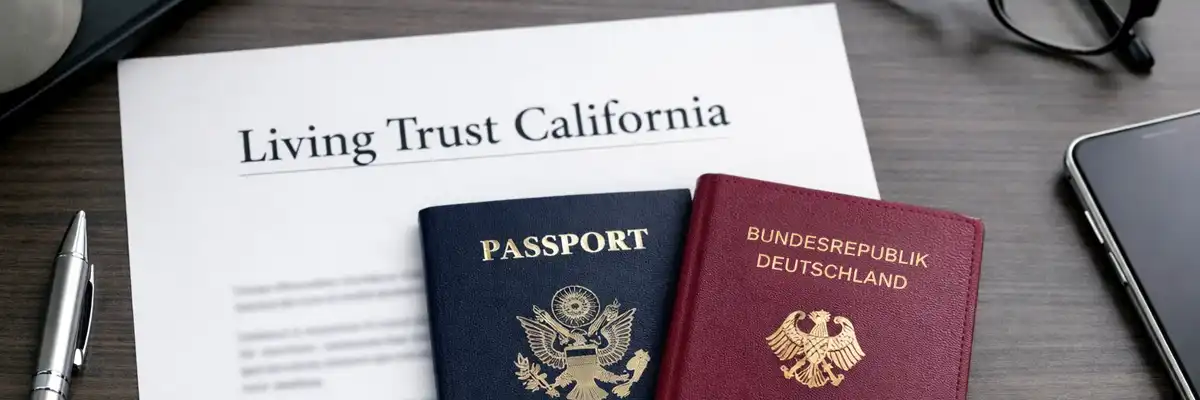
Many members of the German-speaking community maintain assets or family connections in Europe. You may have a German Testament, property in Germany, or beneficiaries living abroad.
A US trust primarily governs US-based assets. It does not automatically replace foreign estate planning documents. Careful coordination is therefore essential to avoid conflicts of law or unintended tax consequences.
In cross-border situations, professional guidance becomes particularly important. Estate planning must take into account not only California probate law but also the interaction with European inheritance rules and potential tax exposure in more than one jurisdiction.
In San Diego, a comprehensive estate plan that includes a revocable living trust, a Will, and related incapacity documents often ranges from approximately $800 to $4,000 or more, depending on complexity.
In addition to drafting the documents, the trust must be funded. That means transferring assets into the trust. Real estate deeds must be updated, and financial accounts may need to be retitled. An unfunded trust does not avoid probate.
While the upfront cost is higher than preparing a simple Will, it should be weighed against potential probate fees and administrative burdens later.
The question is not whether a trust is mandatory. California law does not require one. The real question is whether a trust is strategically advisable in your specific situation.
For many German-speaking residents in San Diego, especially homeowners or those with cross-border assets, the answer is often yes.
A Will alone may technically fulfill basic legal requirements. A trust, however, can provide greater efficiency, privacy, and continuity. In a state with high property values and a formal probate system, that distinction can make a significant difference for your family.
Estate planning in a new country requires adjusting to a new legal framework. A trust is one of the most important tools within that framework. Understanding its role allows you to decide, based on your own circumstances, how best to protect your assets and those you care about.